They Tried To Kill Us. They Failed. So, Let’s Eat A Lot And Get Drunk.

March 23rd, 2013 § 2 comments § permalink

Passover is here. Matzos sit next to Easter Bunnies on supermarket shelves across America. It’s that time of year. Boisterous eating and drinking dominated HG’s family Passover celebration, the Seder, when some 76 years ago much of HG’s family was centered in the Flatbush section of Brooklyn. Though a very young lad then, aged HG still remembers all the details of the raucous family feast. First, a small glass of wine and a tiny plate of food was placed on the table for the prophet Elijah (in the unlikely event that he would manifest himself in Brooklyn). The table was set with the symbolic dishes (these were not eaten) of the Hebrew captivity in Egypt. There was the reading of the Hagaddah, the tale of Passover (In those long ago days, the Hagaddahs were published by the Maxwell House Coffee Company. They were distributed, free of charge, at Jewish “appetizing” stores and kosher butchers. A canny PR move by the coffee merchants). A matzo (the traditional unleavened bread obligatory during Passover) was folded into a napkin and “hidden.” This was called the afikomen and when found by the young members of the family each got a monetary award — a shiny half-dollar. (Many years later, HG learned that when the lucky children of one of HG’s real estate mogul public relations clients found the “afikomen” each were rewarded with a $10,000 check). The big moment for little HG was when he was called upon to ask “the four questions” — the inquiry as to why this celebratory Passover night was different from any other night of the year. The small boy relished the spotlight and asked the questions — spoken in English and chanted in Hebrew — with many bravura, theatrical flourishes. “A regular Thomashefsky!!,” HG’s uncle exclaimed, approvingly. (Boris Thomashefsky was a flamboyant star of the Yiddish stage. The conductor Michael Tilson-Thomas — who shortened the name — is his direct descendant). The serious eating began with copious portions of gefilte fish (a very robust version of the French “quenelle”) with heaps of fiery, freshly grated horseradish. Followed by brisket, copious gravy, roasted carrots and onions plus knaidels — matzo meal dumplings which had a sponge like capacity for soaking up gravy. All of this was accompanied by many glasses of kosher-for-passover Schapiro’s sweet Malaga grape wine (purchased at the Schapiro lower east side winery – now closed). The wine carried a kick so the Seder became louder and more irreverent as the evening progressed. Dessert was a compote of stewed fruit plus special Passover pastries like coconut macaroons. Bottles of Vishniak (cherry brandy) and Slivovitz (plum brandy) appeared and were drunk in abundance. A Seder song, Chad Gadya, a song about the survival of a symbolic kid, was sung and shouted — loudly. More songs. Some secular and even naughty. More brandy drinking. At one memorable Seder, the group was singing: “We love Jesus, yes we do. We love Jesus, yes we do. Hooray for Jesus. Hooray for Jesus. Damn good Jew!!” Two very Irish looking cops appeared at the door. Asked the family to tone things down. Neighbors were complaining. Invited the cops to have a drink They agreed. Big glasses of Slivovitz. HG’s cousin proposed a toast: “To Ireland, a great land.” More Slivovitz and the cops joined in the next toast, shouting with the family, “Next year in Jerusalem.”

Super Congee

March 20th, 2013 § 0 comments § permalink

HG prepared the ultimate comfort food — congee — upon the arrival in New Mexico of Beautiful Granddaughter Sofia. A note to the uninitiated: Congee — also known as “jook” — is Chinese rice porridge, a warming hug of a dish. HG and BSK were converted to congee during their long residence in Vancouver. A few hundred yards from their loft was Congee Noodle House where scores of Asians ate — you guessed it — congee and noodles. Some of the Asian customers added black “hundred year” eggs to their congee. Others accompanied it with fried Chinese crullers. HG and BSK usually added chopped oysters, scallops, prawns or mushrooms to their steaming bowls. When making congee at home, HG uses Ottogi Vegetable Rice Porridge Mix (available online from Hmart). Very savory, much simpler and less time consuming than making congee from scratch. For the Welcome Dinner, HG gave the recipe a twist: In place of plain water, HG substituted good chicken broth (HG likes Trader Joe’s Free Range broth) and shitake infused water (the dried shitakes were sourced from Sante Fe’s Talin International Food Market). Chopped mushrooms were added to the congee and –a few minutes before serving — a pound of shucked oysters and their juices were plunked into the pot. The servings got a topping of chopped scallions. A happy and soothing feast.

Cheap New York & The Surrealists

March 20th, 2013 § 4 comments § permalink

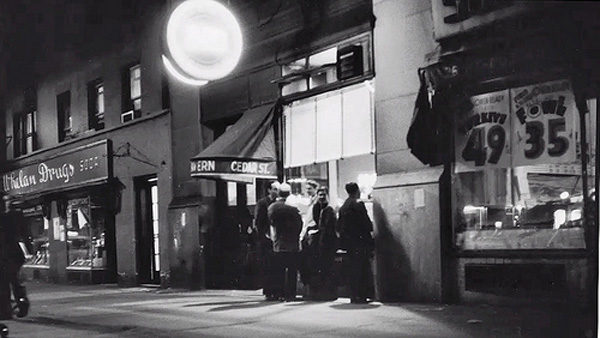
The younger generation is disbelieving when HG mentions how cheap New York living used to be. In the 1950’s a quite liveable one room apartment in Greenwich Village or Chelsea rented for $35-45 a month. In the 40’s, a pastrami sandwich was 15 cents (later raised to 17 cents as wartime inflation took hold). The subway was a nickel and there were ferocious protests when the fare was raised to a dime. (Yes..everything is comparable and salaries were low then and inflation has risen…but still…New York was then an affordable, working and middle class city; now it is a city built for the rich with everyone else struggling to stay afloat). During the 1940’s HG’s beloved late sister Beulah Naomi would take young HG to lunch at Larre’s, a French restaurant on W.56th Street in order to give the young man a taste of European civilization. French was spoken at almost every table as wartime immigrants and high school French teachers paid homage to Francophone culture. This what you got for 50 cents: All the French bread you could eat, of course, plus a small, gratis salad. An hors d’oeuvre cart passed through carrying modest treats like lentils, shaved carrots, string beans. Soup (onion or consomme). A long simmered stew with a fancy French name (either beef or mature fowl). Dessert (usually custard described as “Creme Caramel”). Coffee. No, it was not Henri Soule caliber French food but it was okay. Beulah Naomi and HG didn’t know that during World War Two, Larre’s was the favorite restaurant of a group of artists. Robert Motherwell (then interested in surrealism) and other avant-garde visionaries would lunch at Larre’s twice a week with famed French surrealists displaced by the war — among them Marcel Duchamp and Andre Breton. After lunch, the group would stroll to Third Avenue, then filled with antique and second-hand furniture shops. They would browse these shops trying to determine which objects were “surrealistic.” Duchamp (who gave the world the first “ready-made” piece of art i.e. a hanging urinal) was the final arbiter.

Rhody Rapture

March 18th, 2013 § 0 comments § permalink

The 10-cent Nedick’s hot dog (Nedick’s, now shuttered, was a New York City based fast food chain predating Mickey Dee). The Sabrett’s hot water dog with its odd tomato and onion sauce. The Chicago hot dog replete with “sport” peppers, celery salt, pickles and other greenery. The Bronx kosher deli dog with hot mustard and sauerkraut. The estimable doggie sold in the Costco food court. All of these have provided HG with varying degrees of pleasure. But, HG’s favorite canine can only be found in the small state of Rhode Island. Yes, Rhody is of modest size but it specializes in big, highly idiosyncratic flavors. And, for sheer oddity (as well as a strange, hard-to-pin-down savoriness) the “New York System Hot Wiener” (accompanied by a cold Coffee Milk) stands out and makes HG bark with delight. Permit HG to do a scholarly exegesis on the proletarian pup: The wiener used in a NY System is either the skinless product, the Little Rhody or the Saugy which has a natural English sheep casing (giving it a characteristic snap). Alone, or in a roll, these small sized dogs are certainly good but nothing to write an HG posting about. But, then comes the sauce. Ah, the sauce. The French say cheese is milk’s leap into immortality (When the French get things right, they get them really right). And, the spicy meat sauce that smothers the Hot Wiener makes the tube steak leap into nosh immortality. Created by Greek immigrants in the early 1920s (or somewhere around there) the meat sauce is truly the flavor of the old world (Europe, Middle East) meeting (or meating!) the new. There are hints of Italian Ragu and Greek Mousaka. Bits of Texas chili. Smidgens of Middle Eastern kefta (possibly due to tiny infusions of cinnamon, cumin and possibly all spice). The faintest evocation of Portuguese stews. But, why try to analyze it. Like a kiss from a beautiful woman, just enjoy it and don’t intellectualize. One would think that the sauce could stand alone, No. Rhode Islanders further enhance the Hot Wiener with mustard, chopped onion and celery salt. So, what do you drink with his extravaganza? Just as HG believes the only appropriate drink to guzzle with a New York hot pastrami sandwich is the “Jewish Champagne” that is Dr. Brown’s Cel-Ray Tonic, Rhodys opt for Coffee Milk. This beverage is made with two tablespoons of locally made Autocrat Coffee Syrup mixed with icy milk. Stirred well. Simple. Perfect. HG believes the Rhode Island fondness for coffee milk is somehow linked to the Rhode Island fondness for coffee and donuts at Dunkin’ Donuts. Rhodys are the nation’s largest per capita consumers of donuts (the Providence sports and entertainment center is the Dunkin’ Donuts Arena known to all followers of Providence and Rhode Island University basketball teams as “the Dunk).

Given all of this yummy history, HG’s heart picked up a beat today when he opened a package from the Family R.: Gifted Daughter Lesley, Profesore/Dottore Massimo, Glorious Granddaughters Arianna and Sofia. The little bundle contained a package of Olneyville N.Y. System, R.I.’s Best Hot Wieners, Hot Wiener Sauce Spice Mix (since 1946) plus a bottle of Autocrat, enough to make many glasses of Coffee Milk “The Official State Drink of Rhode Island.” The enclosed card read: “A taste of Rhode Island for Hungry Gerald.” HG has a kind and thoughtful family. HG will sample these good RI things while listening to Blossom Dearie sing: “Rhode Island Is Famous For You.”

Dr. Brown’s Cel-Ray Tonic – The Big Exception

March 16th, 2013 § 2 comments § permalink

HG loathes all of the popular, incessantly advertised, heavily sugared, artificially sweetened and chemically infused carbonated beverages. Coke, Pepsi, Sprite, Dr. Pepper, etc. To HG they seem to be part of a health destroying plot against the American people. Principals in the plot are the evil profiteers who stock the supermarket shelves with these nasty drinks and their collaborators, the “snack” manufacturers. (Recently they have been joined by the brewers of the “energy” drinks — a la Red Bull). HG looks with dismay as women, accompanied by children, wheel their supermarket carts laden with these vile objects. Do they hate their kids? Have they been brainwashed by television hucksters? In the interests of full disclosure and intellectual honesty, HG must admit to a twice-a-year fall from grace. That’s when HG eats a traditional overstuffed Jewish pastrami sandwich in New York (at Katz’s or Carnegie Deli). What Sauterne is to foie gras and Burgandy is to steak — that’s what Dr. Brown’s Cel-Ray Tonic is to pastrami. The companion made in heaven. Of course, Cel-Ray reeks of fraud. It’s flavored with some kind of celery seed extract — not nice, fresh, healthy celery. It certainly isn’t a tonic. (Okay, okay. At some point the FDA made the manufacturers stop calling it a tonic and label it as “Soda.”) And, HG suspects Dr. Brown’s medical school credentials. Nevertheless, when eating pastrami the drink seems to be just what the doctor ordered — the pungent, almost peppery flavor is the perfect foil for the juicy fat of perfect pastrami. It is a very Jewish beverage and only found where Jews abound — New York and South Florida. You can also find it in such Los Angeles heartburn heavens as Langer’s, Canter’s and Nate and Al’s. Cel-Ray had its birth in Brooklyn in 1868 and for generations was known as “Jewish Champagne.” Pass the pickles and sour tomatoes, please.

Peter Alan Meyerson R.I.P.

March 14th, 2013 § 0 comments § permalink

Peter Alan Meyerson died this week in Los Angeles at the age of 82. It was remarkable that he lived to an advanced age since he relished a variety of unhealthy habits: A diet that stressed pizza and Jewish delicatessen (with an occasional visit to a Chinese restaurant). He chain smoked unfiltered Camel cigarettes and was no stranger to mind altering substances. He usually had a rich, mahogany tan, the result of relentless sun bathing. Peter was a dear person, HG’s friend for some 58 years. It is very difficult to sustain sad thoughts about Peter’s passing because, simply put, he was one of the funniest people that ever lived. Yes, he had a many decade career in Hollywood as a comedy writer and producer of such shows as The Monkees, Welcome Back, Kotter (the TV show where John Travolta got his start), That Girl etc., etc.. But, the place where his humor was best expressed was in his wild improvisations. In New York, on Fire Island, in Hollywood delicatessens…Peter reduced his friends to weakness-in-the-knees as his comic riffs became more irreverent, scatalogical, satirical, surreal. So many memories: Peter doing an routine (complete with patriotic song and dance) that reduced President Lyndon Johnson’s actions in Vietnam to a mad travesty. Peter (looking very furtive) asking a porn shop clerk: “Do you have anything with marshmallows?”. Peter narrating a bathing beauty contest for Nuns. All pure spur-of-the-moment creations. Goodbye, unforgettable Peter. You left us the memory of a million laughs.

The Triumph of BSK Vegetables

March 11th, 2013 § 0 comments § permalink

“Eat your vegetables!!” “Finish your brocoli — or no dessert!!” “Eat them — they’re good for you!!” Yes, as children, we were all subject to threats, pleadings and promises regarding vegetables. And, naturally, this has led to resistance. What didn’t come across was the fact that vegetables, if treated properly, are very tasty and worthy companions to good red wine. Witness the roasted vegetable platter prepared this week by life companion BSK. Neither a doctrinaire vegetarian nor a rigid health nut, BSK nonetheless glories in vegetables and treats them imaginatively and with dignity. For the vegetable dinner, BSK filled a baking pan with cauliflower florets, slices of red pepper, radishes,fennel slices, chick peas, chunks of turnip and carrot, Brussel sprouts. This colorful melange got a nice dousing of garlic infused olive oil plus a sprinkling of ground pepper, kosher salt and Goya Adobo. For crunch, BSK topped the vegetables with some finely chopped pancetta (a bow to HG’s infatuation with Italian piggy products). Into a 375 degree oven. Roasted into levels of crisp and unctuous. BSK also cooked some quinoa with onions and mushrooms in chicken stock. This was the centerpiece of the vegetable extravaganza. A companion was a very big bowl of Greek yogurt enriched with oil, garlic, Tsatziki spices, some preserved lemon and piquant Spanish smoked paprika. Adding a Middle Eastern touch was a small dish of harissa. Delicious. Some worthy folks like George Bernard Shaw and I.B. Singer were dedicated vegetarians. HG doubts they ever tasted anything as good as BSK’s creation even with the pancetta and chicken broth eliminated.

Skinny Pastas

March 9th, 2013 § 0 comments § permalink

In a recent New York Times piece, chef/restaurateur Mario Batali noted that a favorite dish is “Spicy vermicelli with anchovies, hot pepper and bread crumbs.” BSK made a variation of this dish last night. BSK got rid of the bread crumbs and added garlic plus flash-fried squid. Substituted capellini (“angel hair”) fot the thicker vermicelli. BSK and HG like this skinny pasta and (slightly thicker) fedelini. Be forewarned, this pasta cooks in a flash. If serving at room temperature, douse the cooked pasta with cold water and drain thoroughly to stop it from over-cooking.

Room temperature or chilled vermicelli is a standard accompaniment to many Asian dishes. BSK often serves it (with a shot of sesame oil and a dab of sambal oelek or a squirt of sriracha) with Mapo Tofu or alongside sauteed bok choy and steamed mustard greens. BSK also makes Taiwanese Oyster Soup (google the recipe) with gently poached oysters, vermicelli, stock, rice wine, soy sauce, etc. Chinese noodle soup with a skinny twist.

Noshing Through Noir At The Ascot

March 7th, 2013 § 0 comments § permalink

At 13 years of age HG was a busy little guy. Following after- school punchball or association football, HG would cruise Kingsbridge Road in the Bronx and help the shopping women. “Carry your bundle, Lady?” said endearing HG and this meant trudging, while heavily laden with shopping bags, up five stories of an apartment house for a nickel or dime tip. A parental allowance was beneath HG’s dignity. HG had to hustle in order to indulge in HG’s Saturday afternoon aesthetic and culinary treat. This was the double feature at the tiny Ascot Theater on the Grand Concourse. HG would pick up some chunks of dry, garlic salami (“a nickel a shtickel”) at the Tower Delicatessen plus two sour dill pickles at a neighboring “appetizing” store (these pickles were plucked fresh from a barrel). Armed with food and a pack of war-time Rameses cigarettes (yes, HG was a smoker even then, a habit he cultivated for some 50 years), HG lounged (and nibbled and smoked) in a balcony seat and succumbed to the joys of European cinema. The Ascot played only art films, mostly French and Russian (and the occasional American film like John Ford’s The Informer.) HG was enthralled by the French “noir” movies starring Jean Gabin (Port of Shadows, La Bete Humaine). Gabin was HG’s favorite movie hero and HG was gratified to learn that Gabin, during World War Two, left a brief Hollywood career (and a blazing romance with Marlene Dietrich) to join the Free French army and fight with the Allies in North Africa. He won the Medaille Militaire and Croix de Guerre and was part of the first contingent to enter liberated Paris. HG’s two favorite films that he watched at the Ascot were Le Grande Illusion (directed by Jean Renoir and starring Gabin) and aforementioned The Informer (starring Victor McLaglen playing “Gypo Nolan.”). HG still recalls Gypo’s last words in the film: “Frankie, your mother forgives me!!”

Years later the Ascot stopped showing art films and devolved into a house of pornography which did not last for long. At last glance the glamorous Ascot was subdivided into a variety of retail spaces while retaining vestiges of its lovely terra cotta facade. In 1988 the writer Avery Corman wrote a nice piece about this stretch of Grand Concourse for the New York Times. It is still relevant today.

Hats and Girdles

March 6th, 2013 § 3 comments § permalink

When HG was growing up, men wore hats. Fedoras for the most part and Homburgs for the rich old guys. There was a switch to Panamas (real and faux) during the summer. Some dudes wore straw hats (known as skimmers or katies.) Among kids there was a New York City legend that you could knock, with impunity, a straw hat right off a man’s head if it was worn after Labor Day. (HG Never saw it happen). And, women wore girdles, thus creating the anatomic oddity — uni-buttocks. Only very racy damsels jettisoned girdles for garter belts. (This was HG’s experience. Admittedly, a quite limited experience but not for want of effort.)

It seems men’s hats are making a modest comeback. SJ, always in style, has been seen sporting an attractive fedora. Girdles, fortunately, are at one with the corset and the buggy whip. Gone forever. Cocktails seemed to be disappearing a few years ago in favor of wimpy glasses of white wine or even wimpier glasses of mineral water. Now, hip diners all over the country are demanding creative pre-dinner libations. And, they seem to be willing to pay the price. Are women still cocktail addicts? They were in HG’s young manhood (there were even cocktail dresses designed specifically for the Happy Hour). Many times HG happily observed suburban ladies in Sardi’s knocking off two (or even three) Manhattans or Martinis during a pre-theater matinee lunch. And, they could meet the challenge of alcohol. Lots of smiles. Lots of laughs. But, definitely not blotto. Which was more than HG could say about the Martini swigging macho guys falling off stools at Sardi’s bar.