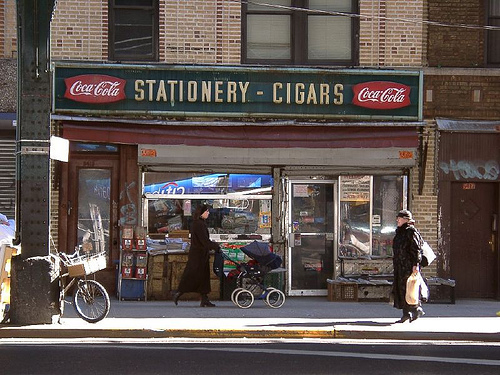
New York used to be a city full of candy stores and cigar stores. The classic New York candy store carried regional NYC treats (Little Chunkies, Goldenberg’s Peanut Chews and Joyva Halvah) in addition to the national candy bar brands like Hershey, Nestle, Mars, etc.. It usually had a soda fountain dispensing egg creams, glasses of seltzer (“two cents plain”), milk shakes, “malteds” and simple sandwiches and coffee. It also sold cheap toys and some stationery items (“school supplies”). Cigarettes and cigars, naturally. There was a rack of magazines and comics and outside there was a newsstand. Well into the 50’s New York had four afternoon newspapers (Post, Sun, World-Telegram, Journal-American) and four morning papers (Times, Herald-Tribune, News, Mirror) and for a time, the super-liberal PM (later re-named The Compass). There were loads of foreign language papers: The Forward, Day, Morning Journal, Il Progreso, La Prensa, Aufbau, etc.). There were even two communist newspapers, The Worker (in English) and Freiheit (in Yiddish). After dinner, men strolled to the neighborhood candy store to get the early edition of the News and Mirror. The News was the better, sharper paper but the Mirror had the Walter Winchell column and the latest racing results (a necessity for the inveterate horse player).
The candy store was the hangout of bookmakers, gamblers and money lenders (known as “Shys”). Except in the Times Square neighborhood (where there were no candy stores), New York’s cigar stores didn’t attract quite the same sporting element. Candy stores flourished in Jewish neighborhoods. The tough Brownsville neighborhood of Brooklyn was a predominantly Jewish neighborhood. The lethal Murder, Inc. flourished there. It was typical that the Jewish contract killers (“Kid Twist”, “Pittsurgh Phil”. Albert “Tick Tock” Tennenbaum, etc.) didn’t hangout at bars. Their hangout was a candy store called Midnight Roses’s. When little HG visited his Brownsville cousins they were pointed out as neighborhood celebrities. The Brownsville prize fighters — Al Davis, Morrie Reif, Schoolboy Friedkin, etc. — had their own candy store gathering place.
Consistent readers of Hungry Gerald may have noticed that HG eats a lot of fish and vegetables plus quarts of olive oil and an abundant amount of garlic. Reasonably healthy stuff. HG enjoys the sea, Prince Edward Island and New Mexico. Most of all he enjoys (and loves) BSK and his wonderful family of food and wine and art and literature and music lovers. Thus, HG wants to live a long time. Legend has it that garlic keeps vampires away. HG presumes it also scares the Moloch Hamoves (The Angel of Death). But, there are times when HG neglects oil and garlic and revels in the forbidden meaty flavors of pig (Tamworth and Berkshire pigs, of course). Like last night. HG spread wheat bread with a product he obtained from Lloyd’s Specialty Meats at the Cardigan Farmers Market — potted meat. That was the Scotch-Irish description. But, in realty it was rillettes, that robust staple of Parisian bistros. Essentially, potted meat (or rillettes) is lard, pork shoulder and pork spare ribs cooked down into a jam-like spread. In fact, the French often refer to it as confiture de cochon (pig jam). No matter what you call it, it is delicious. Not exactly on the cardiologist’s most recommended list of heart-healthy snacks. HG sprinkled his potted meat with Maldon smoked sea salt flakes and accompanied it with local mustard pickles. HG Followed this with fettucine made carbonara style with raw eggs, back bacon, parmigiano cheese and ground black pepper. Plus fried discs of young zucchini and some just picked green peas. As a further bow to healthy living (and it tasted good — a big green salad.
The fire news from Colorado has been tragic. Many of HG’s friends have been in real danger of losing their homes. But, amid all the horror there has been a cool place to escape and dine. HG refers to 240 Union Restaurant in the Denver suburb of Lakewood. When HG and BSK stop in Denver (to make flight connections) they always have a meal there. One of the delights of 240 is the owner/host, Michael Coughlin. Besides having loads of Irish charm and conviviality, Michael knows how to assemble a wine list. His 23 for 23 group is an affordable pleasure — 23 varied (and tasty) wines for 23 bucks each. At dinner recently, HG and BSK had a dozen oysters (six Atlantic and six Pacific) with glasses of Prosecco. Michael uncorked a bottle of Oregon Pinot Gris from the “23” list (very crisp and similar to the British Columbia Okanogan Valley wines HG and BSK cherish). A platter of fried calamari imaginatively accompanied by fried shishito peppers followed. HG and BSK then shared some traditional English fish and chips (better than any HG has had in London). Dessert was a shared bit of very light lemon cheesecake with a blueberry coulis.
Colorado cuisine has come a long way from the days when it was dominated by hamburgers and tacos. Hope the fire season is over and gracious Western living — as exemplified by 240 Union — returns.
Okay, pals and buddies, let HG tell you about the perfect summer lunch. The place: Cookshop on 20th and Tenth Avenue (one of three downtown New York restaurants run by HG daughter Vicki Freeman and chef/husband Marc Meyer. The others are Five Points and Hundred Acres. All superb). HG and BSK’s luncheon companion was Stephanie Pierson, author of The Brisket Book among many other rollicking prose accomplishments. It is very hard to have a bad time when Stephanie is around. She’s a true wit with a flair for friendship, laughter and good food. She is also the creator of the world’s best chicken pot pie.
So, what did Vicki and Marc serve the trio on a more than tepid late June day? Long Island Blue Point oysters (briny jewels). Fried zucchini blossoms stuffed with smoked mozzarella. Crispy Rhode Island calamari with capers and a state of the art aioli.(Yes, there were white wine spritzers for HG and non-alcoholic pleasures for the ladies). Grilled shrimp salads (for HG and Stephanie. BSK is allergic to crustaceans). Chicken salad for BSK. Sound mundane? Not when the salad contained the very best, fresh-from -market vegetables and perfectly cooked, heritage chicken. Finished with a nicely curated cheese platter .Cookshop was busy and bustling (as it deserves to be) during this weekday lunch. A snappy crowd. At a neighboring table were two black suited, white shirted guys from Italy. The stylish gents ate some huge salads and did a lot of damage to a bottle of red wine. Permit HG to assure you. The HG party didn’t get special treatment. Vicki, a warm and glowing soul, makes everyone welcome. Marc, a pioneer in barn-to-table cuisine, uses only the best ingredients and then gives them a creative tweak that makes the diner stop with fork in mid-air and say “Wow!!”. HG advice: Get over there. Say HG sent you.
Chaika (later Anglicized to “Ida”) Kopkind Freeman, HG’s Mom, was born (late 1880’s, precise date vague) in the tiny town of Plestyanitz in present day Belorussia. When she was a little girl, a traveling circus came to town. The star was a black African. You had to pay extra to see him and for an additional tiny sum you could rub the man’s arm to prove the ebony color wasn’t painted on. Mom arrived in the United States in the early 1900s. She and her female roommate would often leave their tenement for a stroll on The Bowery, then a lively entertainment center. “What a country!!,” Mom would marvel,” Here there’s no charge for looking at black people.”
Many years later, Mom lived in The Bronx with husband and three children. The energetic woman cooked, cleaned, mended, washed and, blessed with nimble fingers, made shirts, scarves and dresses. During the last stage of the Great Depression (around 1938), African-American women from Harlem would line up on major Bronx streets in middle class neighborhoods and be hired for a day’s domestic work. Their pay was very modest and angry leftist newspaper columnists derided it as “Bronx Slavery”. At some point, HG’s older brother persuaded Mom to hire a woman for a day so she could have some rare leisure time. Mom was a Socialist and an early union member. She had friends who died in the tragic Triangle Shirtwaist fire. Suffice it to say, she was very uncomfortable with the idea of hiring a house-keeper (even for a day). Before the cleaning woman began her work, Mom cleaned house. “You want a stranger to think we live in a dirty house?” Mom didn’t quite get the idea. Filled with guilt, she made the bemused African-American woman a sumptuous lunch. Tuna salad and salmon salad. Lots of fresh vegetables and bread. A big fruit cup for dessert. “Bronx Slavery” ended as the war boosted the economy. That was Mom’s last experiment with having a servant or “help.” To little HG’s distress, when heavy cleaning was necessary Mom called on HG. Left HG with a lifelong aversion to domestic labor of any kind.
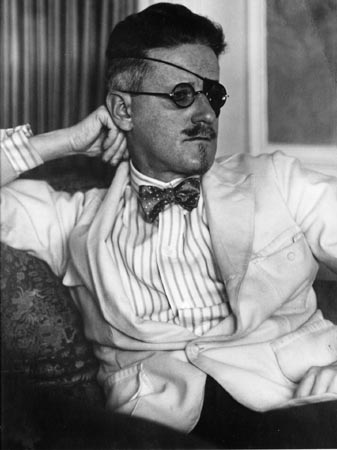
June 16 was Bloomsday a day of celebration and commemoration of the life of the writer James Joyce and his extraordinary novel, Ulysses. The day refers to the June 16 in the novel. The day in which all of the action takes place during the one day peregrinations throughout Dublin of its Jewish hero (or anti-hero), Leopold Bloom. HG was introduced to the wonders of Joyce in his CCNY college days by Prof. Theodore Goodman, a legendary figure at City College. Goodman taught a course devoted to writing short stories. Students wrote stories. Read them aloud. These were then criticized by Goodman and fellow students. Criticism was withering. To say the least, punches were not pulled. The class text was Joyce’s collection of short stories, Dubliners. The Joyce stories were meticulously analyzed under Goodman’s direction. We leaned there were no accidents in these stories. They were pieces of prose architecture, each word essential in the total framework. It was a humbling experience for embryonic writers. Goodman was elderly and in frail health. Sometimes he missed a class. HG and his mates waited outside the classroom hoping that he would show up. There was a feeling of dread. We loved him, even though he was no Mr. Chips. He was tough and his one-to-one conferences with students could be a scalding experience. Goodman lived through his class with HG and gave HG an “A.” Whenever experience lowers HG’s self esteem, HG remembers that “A.”
In a recent review in The Economist of a Joyce biography by Gordon Bowker, the reviewer noted: “The hero of ‘Ulysses’, Leopold Bloom, was born out of Joyce’s affection and fascination with Jewish culture; which would lead him, in turn, to help several Jewish men and women escape Austria and Germany during the second world war.” It would have been appropriate for HG to celebrate Bloomsday by accompanying a bialy with cream cheese with a glass of Dublin-brewed Guiness Stout. But, in the absence of bialys in New Mexico, HG had to be content in raising a snifter of kosher Slivovitz to the memory of Joyce, a gifted (and difficult) man.
Later this year, during the Christmas season, HG and BSK will watch The Dead, the John Huston cinema version of the longest story in Dubliners. In HG’s opinion, this is the finest cinema version of prose fiction ever achieved.
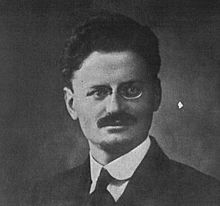
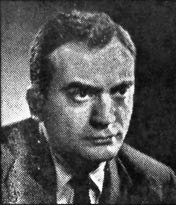
Spent a delightful hour chatting on the phone with Miranda Wolfe, daughter of the late Bernard Wolfe, an extraordinary writer who wrote just about everything: novels, short stories, journalism, ghosted Broadway columns, television, screen plays and customized pornography which he produced for one reader — an Oklahoma oil zillionaire (Wolfe was in good company in this customized porn business as the eccentric Oklahoman also hired, amongst others, Henry Miller, Anais Nin and Gene Fowler. What they all had in common was a need for quick cash). Sorry. Don’t want to emphasize the pornography. This was just a miniscule portion of Wolfe’s output (and he found it distasteful). Make haste and read BW’s works.. A good start would be Really The Blues which he wrote with jazz musician Mezz Mezzrow. (This book heavily influenced influenced the Beat Generation of writers — Kerouac, Ginsberg, etc.. For a treat, listen to some of the music forgotten Mezzrow made with Sidney Bechet. Check it here!). The Late Risers defined the cool Broadway hipsters of many decades ago. The Great Prince Died is a historical novel based on the Mexican exile of the great Russian revolutionary and anti-Stalinist, Leon Trotsky. Later, the title was changed to Trotsky Dead. At one time, Wolfe was bodyguard/secretary for Trotsky (he wasn’t present when Trotsky was pickaxed to death by a Stalin assassin).
Wolfe had quiet sartorial elegance and a well stocked mind. Unlike many writers, he excelled at both talking and listening. HG enjoyed some memorable dining with Wolfe. Bernie’s favorite restaurant (and HG’s) was Fornos. a happy Spanish place that flourished on West 52nd Street many years ago (here, BW was formally addressed as “Senor Lupo”). The excellent food was preceded by classic Margaritas and ended with Banana Daquiris. Very hard to leave sober. Bernie liked the Oak Room of the Algonquin hotel where he would compose his meals carefully and creatively after some knowledgeable consultation with the waiter and captain. Alas, the composition of a meal is a skill that has virtually disappeared in New York (but, not in Paris).
In the 50s and early 60s Russian and Iranian caviar was cheap (If you listen closely you may hear the sound of teardrops falling on HG’s keyboard). HG recalls a caviar feast HG (and his ex-wife) hosted at their town house apartment in the Gramercy Park neighborhood. Some two pounds of Beluga (from Caviarteria) were devoured with thin, buttered white toast and washed down with abundant, icy Polish Wyborowa Vodka. In addition to Bernie, the other guests were screenwriter/painter/novelist Fred Segal and his then wife, Sandra. The caviar was followed by cognac and Upmann Brevas cigars, Maduro leaf. Not exactly an homage to healthy living. HG and his ex-wife survive. The others, sadly, are gone. Miranda Wolfe is busy working on Bernie’s voluminous and distinguished literary legacy. Hopefully, many gems will be reissued. Pornography has been described (by the French, of course) as books read with one hand. HG will be reading the reissued Wolfe works with one hand. The other will be clutching a glass of ultra chilled Polish vodka.
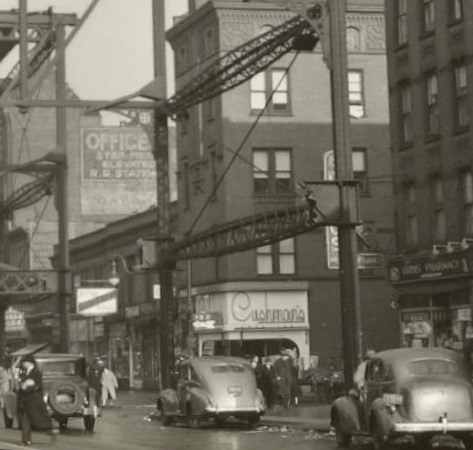
In 1930s New York, many apartment buildings, shops (and restaurants) were designed in a streamlined, modernist style — a kind of Art Deco for the masses. While true Art Deco (which reached its height in Paris of the 20s and 30s) was very elegant and seriously luxurious, the young American designers who piggy backed on the Art Deco style were a bit more egalitarian. Their best efforts, in terms of major structures, can be seen in the apartment houses that line the Grand Concourse in the Bronx and the glorious hotels of Miami’s South Beach. Smaller design gems were the chain bakeries that flourished in all of New York’s neighborhoods. The aim of all the “streamlining” was to give shoppers an optimistic lift in the gloom of the Great Depression. The “streamlined” bakeries were Cushman’s and Hanscom’s. The famed industrial designer Raymond M. Loewy designed Cushman’s and Horace Ginsbern designed Hanscom’s. (Ginsbern, then fairly young, later became one of New York’s most prominent apartment house architects. Ginsbern was born in 1893 and died in 1969. Scores of his buildings exist in Manhattan’s Upper East Side).
The architect Robert A.M. Stern has commented on the Loewy and Ginsbern bakery designs: “They brought a relatively high level of International Style Modernism into virtually every New York neighborhood.”
Cushman’s had white porcelain facades; nautical, oval windows and the name was spelled out in a curving, gold script. Hanscom’s had apple green porcelain facades and the name was formed with blocky, super- modern letters. Stern described the entire architectual composition as “Constructivist.”
In the Bronx you had Jewish Bakeries and Italian bakeries. The Jewish bakeries had elaborate butter cream cakes and, of course, bagels, bialys, rye and pumpernickel bread, etc. These were jammed on Sunday mornings with Dads buying bread-stuffs for brunch (The casual tweed and camel hair jackets many of them wore were known as “bagel coats”). The Italian bakeries, in neighborhoods like Belmont, had, of course, sublime bread, delicious cannolis, pignoli cookies and other Italian specialties. There was plenty of cross pollination. Jews liked the corn muffins and cookies at Cushman’s and Hanscom’s (which were generalized as goyish bakeries) and there were plenty of bagel and rye bread fanciers among the non-Jewish population. And, of course, everyone loved their Italian baked goods. Some Jewish bakery survivors in Manhattan are Moishe’s Bakery on 2nd Ave, Streit’s, which bakes and sells matzos, macaroons, kichel and other stuff from a 47,000 foot factory on Rivington Street and Kossar’s which bakes and sells bialys and other traditional good stuff from a location near the Essex Street Market. SJ sent HG a batch of Kossar’s products a few months ago producing moans of delight. The eminent food writer, Mimi Sheraton, a woman who knows Jewish food, says a Kossar’s bialy is the only true bialy baked in the United States. HG agrees.
Interestingly, HG’s Mom never called a bialy by that shortened name. She paid appropriate homage by calling it a Bialyosteker Kuchen.
The answer to this question is: Yes and No. If you are talking about food and the price/quality ratio, New York tops Paris. Also, Paris is, for the the most part, a one trick pony. True, many of Paris’ most edgy restaurants and 3 Star Shrines have increased the use of Asian spices and cooking techniques to touch on a type of fusion cuisine; but overall, what you get in the majority of Paris Restaurants is French food. With the exception of Moroccan, other ethnic cuisines are dumbed down to suit conservative Parisian tastes. Compare that to New York which has three distinct Chinatowns each with an enormous amount of eating spots. There are whole neighborhoods in Queens (and in other boroughs) devoted to ethnic dining: Korean, Vietnamese, Indian, Greek, Italian, Mexican, Argentine and Colombian, Russian, Jamaican — and much more. And those are just the outer boroughs. Within Manhattan itself, you are able to go on a veritable world cuisine tour in just a 4 block radius. And, yes, great Jewish pastrami still lives in, alas, fewer and fewer places. Makes Paris seem very provincial. Small town. In addition, New York has steak houses like Peter Luger’s and Spark’s that are true carnivore heavens.
But, Paris still has that indefinable something, Call it charm. Call it elan. Call it sparkle. Whatever. HG is thinking about late night meals at the art deco brasserie Le Vaudeville which seemingly hums with joy and the promise of good times. Brass. Aged, cigarette-smoke stained marble. Perfect lighting. Or, dinner at the brasserie Le Stella on posh Rue Victor Hugo. Low voices. Women who know how to tie scarves. Men in well cut tweeds or blazers. Soaring towers of fruits de mer. Or, the died-and-gone-to-heaven grilled sole drenched in the best butter at Le Dome. Or, the intimacy, warmth and sheer sexiness of many small bistros serving unassuming food. There was a left bank place called Balzar where the clientele and atmosphere were so diverting that the so-so food was forgiven. (Taken over by a chain some years ago, HG does not know if the place still pleases). Other Paris pluses: Steak tartare (always bad in New York); Belon oysters; blood sausage (boudin noir); tete de veau and offal. (An exception: Paris tripe doesn’t compare to New Mexico menudo as served by places like El Parasol near Santa Fe).
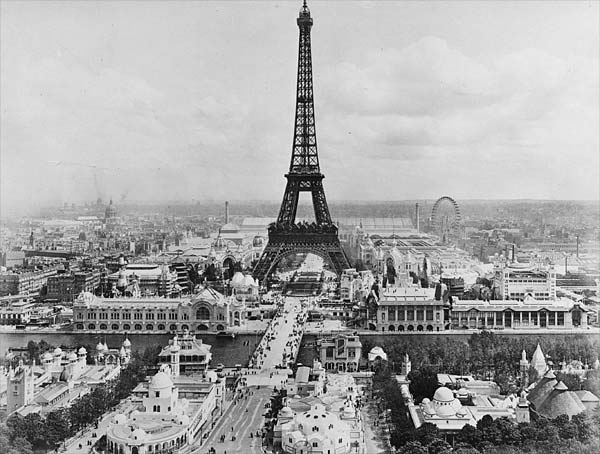
Probably, the most beguiling quality about Paris restaurants is their sheer professionalism. No surprise. The restaurant, as we know it, was invented in Paris. But, if your interest is in variety and getting a dining bang for your buck, New York is incomparable. Yes, “What street compares to Mott Street in July, sweet pushcarts gently gliding by?”. But, an after dinner walk in Paris with the Eiffel Tower sparkling in the distance is nothing to sneer at.
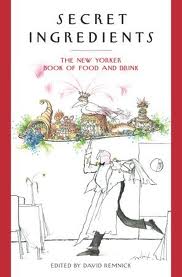
Secret Ingredients: The New Yorker Book of Food and Drink, is an anthology from the pages of New Yorker Magazine and edited by David Remnick. In HG’s opinion, it is the best food book ever created. There are articles that will make you hungry (A.J. Liebling on the Paris restaurants of his youth; Joseph Mitchell on the old New York steak dinner or “beefsteak”; Joseph Wechsberg on French chef Fernand Point). Some will make you think (Adam Gopnik on French cuisine). Some will make you laugh (Calvin Trillin, Ogden Nash, Steve Martin, Dorothy Parker, Woody Allen and S.J. Perelman). Some may make you weep (Alice McDermott’s bittersweet fiction, “Enough,” on the varieties of appetite and desire). And, there’s one that may make you queasy. HG refers to “A Rat In My Soup” by Peter Hessler. The intrepid author visits Luogang, China, where two restaurants, The Highest Ranking Wild Flavor Restaurant and the New Eight Sceneries Wild Flavor Food City specialize in rat (yes, some tasty cat and snake dishes are also available). Hessler dines on Simmered Mountain Rat With Black Beans and Spicy and Salty Mountain Rat. He discovers, no surprise, that rat really isn’t very tasty. Anyway, “Secret Ingredients” is savory fare, indeed