April 24th, 2011 § § permalink
SJ is back in Brooklyn tending to biz but daughter-in-law Exquisite Maiko and grandson Inimitable Haru remain in New Mexico for a few more days. This means pure Maiko Magic in the kitchen. HG and BSK were dazzled last night by a halibut, salad and Soba noodle dinner that exemplified the Maiko approach: Simplicity. Purity. Taste. Visual beauty.
HG watched the preparation carefully but might have missed some steps or ingredients. First, Maiko sliced cucumber paper thin, washed and dried baby arugula and some other field greens; sliced garlic very thinly. Halibut was cut into slightly larger than bite size pieces. Garlic and seaweed went into a sizzling pan. The garlic and seaweed quickly crisped and were placed on a paper towel to drain. The garlic was perfectly crisp and brown with none of the bitterness that burning can cause — its a cooking trick HG has never mastered. Then came the real magic part. Heat under the pan was raised to moderate. The fish went into the pan with some white wine and a bit of sesame oil. The pan was covered and the fish was alternately seared by the heat and steamed to perfection.
Maiko arranged a platter. An enticing circle of cucumber and a mound of salad greens as the base for the fish. Acting upon some clock in her head, Maiko removed the fish from the range, placed the pieces on the base of greens, sprinkled all with pan juices and topped it with the crisp garlic and seaweed mixture. There was room temperature Soba on the table, enriched by Mentsuyu (a broth of sorts) and thin strips of nori (the dried seaweed that wraps sushi rolls and hand rolls). Wasabi was at hand. HG and BSK were startled by the halibut. Not a favorite fish, considered tasteless. But, this was halibut full of juice and flavor. The garlic chips didn’t mask the taste but just added a crisp counterpoint to the lush halibut. There will be more fish tonight. We are grateful to the Shinto gods, Japanese culture and Maiko’s wizardry.
April 21st, 2011 § § permalink
Eggplant Parmigiana is a bad dish. HG never enjoyed it. Basically, a piece of oil soaked fried eggplant, rubbery mozzarella and insipid tomato sauce. What’s to like? Same goes for Veal Parm. Good way to destroy delicate, tasty meat. HG opts for classic Wiener Schnitzel. HG never liked Minestrone. Why have this meaningless vegetable soup when you can splurge on Pasta e Fagioli (the beloved “Pastafazool” of Fiorello H. LaGuardia, New York’s best Mayor) ? Fritto Misto, the Italian melange of fried fish and shellfish pales in comparison to my daughter-in-law Maiko’s Tempura. Maiko’s Tempura is as exquisite as she is. Handling chopsticks with maestro deftness, Maiko produces pieces of shrimp, sole, halibut and scallops of ineffable lightness without a trace of oil. Just crispness. Fresh sea tastes. Eat her sea nuggets fast or they’ll float off the plate. Pass that chilled sake, please. Uh oh…Is HG getting in trouble with the Italian Anti-Defamation League?.
April 20th, 2011 § § permalink
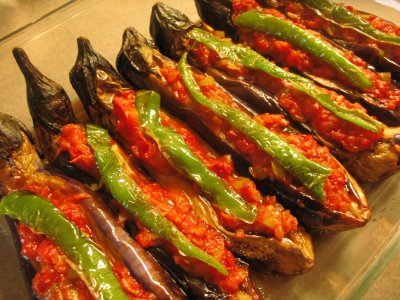
There is an eggplant dish, Turkish in origin, called Imam Bayildi.An overrated bit of food, in HG’s opinion. Essentially, you scoop out the soft interior of a long roasted eggplant. Mash it with tomatoes, onions, etc. Blanch the exterior of the eggplant. Recompose the eggplant into round or oval slices and bake them in the oven. Is it worth all the bother? No. HG will stick with the much simpler Baba Ghanoush. “Imam Bayildi,” roughly translated from Turkish, means “the Imam fainted.” Culinary lore has it that that a Turkish Imam passed out with delight when he first tasted this dish.
HG’s commentary: This must have been a very austere Imam leading a very monastic life in the desert. A more legitimate treat (sex, for example) would have killed him. 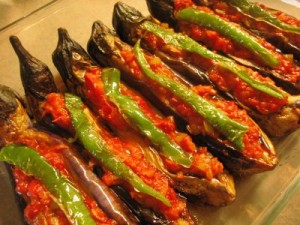
April 13th, 2011 § § permalink
I longed for dumplings before I even knew what longing meant. Yes…the classic Chinese, crescent-shaped, fried dumpling filled with pork and chives. My sister, LR and I loved them. We loved the ritual mixing of the soy sauce and vinegar; we loved that they came first at any Chinese meal; and finally we probably loved that there were never enough — at 6 to an order, our family of four always had 2 orders…3 each! Not Enough!!!!! When LR first got a boyfriend who had a car she quickly got him take us to this Chinese Restaurant in Teaneck, New Jersey whose dumplings were bigger than average, seriously juicy and had a fine balance between a crispy bottom and tender exterior. It was an act of true kindness to an annoying younger brother. With no parents around to say no, my sister and I went for the pay load — we ordered 8 orders of dumplings. We were finally going to have our fill. And we did. And it was genius. It was better than we could have imagined to shuck off the trappings of a meal and simply focus on what we really wanted all along. Needless to say, the boyfriend knew that he had been used by two dumpling obsessives as he pitifully tried to order Egg Foo Young. He did not last, and my sister ended up marrying a wonderful man who would happily join us for a mad 10 order dumpling fest with narry a blink of the eye.
As the years went by, my dumpling obsession did not cease. I knocked off thousands of orders of fried dumplings and expanded my horizons with Russian Pelmini, Polish Pierogi, Uzbeki Manti, Korean Mandoo, Japanese Gyoza and more. In my 30s, I sat once again with my sister at New Green Bo on Bayard Street and, still giddy to be free of all parental constraint, ordered an ALL DUMPLING meal of Xioa Lung Bao (Shanghai style Crab & Pork “Soup” Dumplings), fried dumplings and Schezuan Wontons in hot chili oil. Delicious.
My wife, the lovely Maiko, is Japanese and we were married in Tokyo. HG and BSK were in attendance. After the wedding, we decided to take both sides of our respective families to Kyoto for our honeymoon. While we loved the company and Kyoto itself, translating between, not just languages, but some general cultural concepts was a touch trying and a bit stressful for both me and my new bride. One night, we escaped our families and walked down from our hill-side hotel into the center of the city; swaying through the ancient streets and narrow lanes, I spied a dank, dirty store-front pulsating with the neon visage of yes…you guessed it…a dumpling. It was a clarion call we could not avoid. Inside, the ancient chef/owner confirmed that they only made one thing. Gyoza, and one type of gyoza at that. Though stuffed from a dinner finished not an hour before, we made our order and watched as the chef, with custom-made implements coaxed out a plate of 6 (what? Is there a world-wide dumpling standard?) perfectly identical dumplings bound together with a lacy sheet of golden brown, fried rice flour. We sat together on a tiny bench, armed with chopsticks and cracked that crunchy crust, dipped them in the soy and vinegar sauce and lifted those gyoza to our mouths. The rice flour crunch acted as a hearty welcome as the silken dumpling skin began to dance on our tongues. Oh yes! It was dumpling excellence taken to a power of what seemed to be infinity. It was a dumpling that took the basic dumpling components and elevated them — where some dumplings could be heavy, these were light; and yet they were unctuous and bursting with juice and porky goodness. We smiled at each other and really had to laugh — we had just spent a week of incredible Japanese wedding banquets and traditional Kyoto style Kaiseki meals, but these dumplings, these luminous gyoza were the high points of our culinary adventuring.
Well…back in New York, we started our married life. While we both had two busy schedules, I began to discover that Maiko could cook. Seriously cook. I would come home to discover the lightest tempura or a 2 week stint where pig heads slowly bubbled away to create a broth for a ramen soup that took my breath away. And then one day I came home and Maiko promised me a surprise. I waited patiently, listening to the sounds of cooking and finally she came to me with a platter of what I can honestly describe as the most gorgeous dumplings I had even seen — it was an abundance of dumplings! 25 or 30 of those crescent shaped gems bound together with that lacy filament of delectable rice flour crunchiness. And best of all, there were no side dishes or main dishes or any other type of dish to distract from the very dumplingness of it all.
And so I ate.
Where those great Kyoto dumplings had one perfect note, one perfect flavor, Maiko’s reached that note, sustained it and then followed it with a back beat of other subtle tastes and nuances. Simply put, she ascended the heights of the Kyoto dumpling pinnacle, stuck her flag in it and somehow went even higher.
I had an epiphany at that moment. Like that delicate rice flour crust, my existence had always seemed so fragile. It was a life predicated on the galloping momentum of my ancestor’s random choices and lucky escapes which finally led to a sperm in a million hitting an egg and creating me. But, as that dumpling coursed through my system, I questioned that randomness for the first time. How could it be anything but fate that one of the world’s finest dumpling eaters would meet a woman from across the globe and marry her only to find out that she was the world’s greatest dumpling chef?
The answer to that riddle my friends, in the most simple of words, is love, sweet love.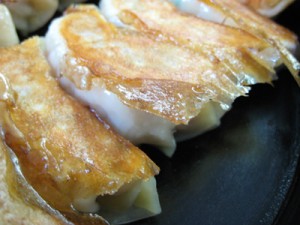
April 9th, 2011 § § permalink
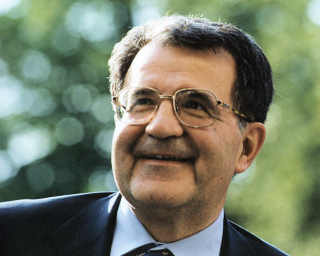
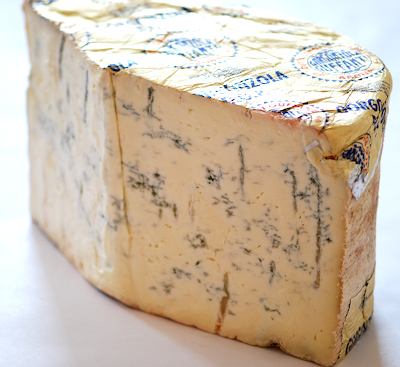
HG’s gifted daughter LR and her distinguished husband, Profesore/Dottore MR, hosted Romano Prodi at dinner in their Rhode Island home last week.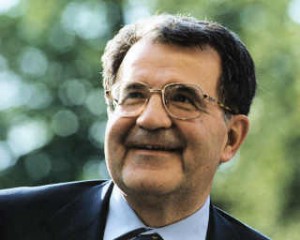 Prodi, a voice of political and economic sanity in an increasingly crazy and disjointed world, is the former Prime Minister of Italy and President of the European Commission. Because of his low key manner, unusual in an Italian public figure, he has been nicknamed “Valium.” Less flattering, he has been nicknamed “The Mortadella.” That’s because he is a bit round, a bit pink and is from Bologna (birthplace of that delectable salume). This has led HG to muse on the subject of food nicknames. As noted in an earlier post, Charles De Gaulle was “La Grande Asperge”, of course. New York’s late and lamented Mayor Fiorello LaGuardia was often greeted by shouts of “pastafazoole” because of his stated fondness for pasta e fagioli. Any other nicknames? Of course, many big wigs and titans of industry have been called “The Big Cheese” but given the recent, rotten actions of the Republican party, HG may well dub them, the “Overripe Gorgonzola.”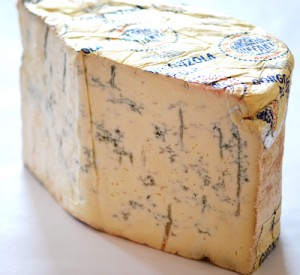
April 7th, 2011 § § permalink
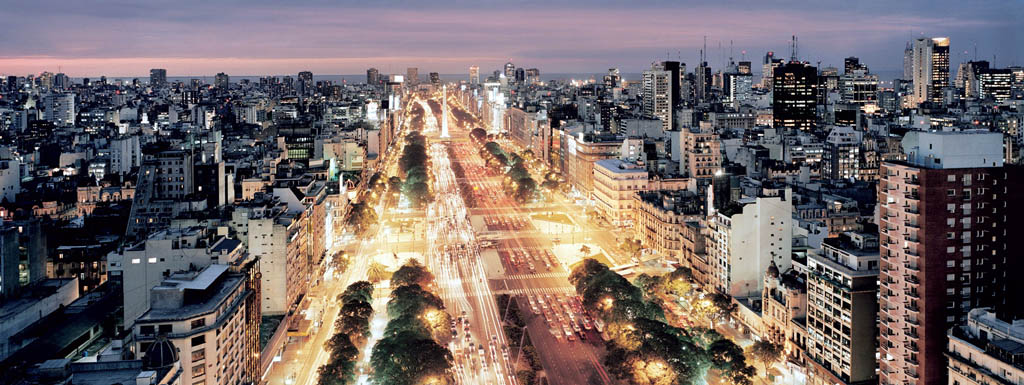
HG and BSK spent two delightful weeks in Buenos Aires last year. The November visit coincided with BA’s early, warm summer. Nice, bi-level rental apartment in a chic building (across the street from the beautiful Museum of Modern Art) with a big, heated swimming pool. HG and BSK had a daily morning and pre-dinner swim.
BA is just beautiful. Majestic boulevards, Lush jacaranda and other foliage everywhere. Charming old neighborhoods that haven’t been gentrified out of character. An abundance of bistros, boutiques, outdoor cafes. Some very interesting galleries and art museums. There are weekend street markets with some bargains and an abundance of street bands. Music and song of much vitality and personality. BA is world HQ for Tango…to dance or to watch. Tango dancers come in all ages and all sizes and all look sexy.
The exchange rate favors the US dollar so everything is amazingly cheap. Example: Fabulous steak dinner with a bottle of Malbec is $10-15. BA is carnivore heaven. Argentine grass fed beef is tasty and tender with real beefy goodness. And, everyone in Buenos Aires, man, woman, and child, devours tons of it. There is lots of imported Spanish ham in the food shops so HG and BSK sampled the best at ludicrously low prices. Besides red meat, BA folks feast on ice cream. Ice cream (as well as cake, bread, pastry, etc.) is often smothered in dolce de leche, the addictive caramel topping. One would think that a population that exists on red, meat, ice cream and dolce de leche (also pizza, which is another BA obsession) would be a fat population. Not so. Best looking folks HG and BSK ever people-watched. There’s a secret, but nobody’s telling. How sweet it is!
March 27th, 2011 § § permalink
HG hasn’t had a hot dog in years.
In the past, HG loved these regional hot dog champions: The hot dog with mustard and sauerkraut at Nathan’s Famous in New York’s Coney Island with ocean breezes and the noise of the roller coaster in the background; Chicago’s Vienna Beef dog with all the fixings…tomatoes, onions, hot peppers, pickles, mustard, celery salt on top of a snappy all-beef wiener; the stupendous hot dog served at a shack in Cliffside Park, N.J. (so good that owners opened a big, formal hot dog restaurant which, of course, failed…you can’t formalize a lowly dog); the excellent, dirty water hot dog served at the fast food counter in New York’s Port Authority Bus Terminal on 8th Avenue.
The true appetite quenching dog was known as “The Special” and was served for many years in New York delicatessens. It was BIG, fat and juicy. More a knockwurst than a frankfurter. As reported in a post some months ago, HG was very fond, in the early days of their marriage, of BSK’s grilled hot dogs served with baked beans mixed with sauteed onions and Heinz chili sauce. Love might have had something to do with it.
March 27th, 2011 § § permalink
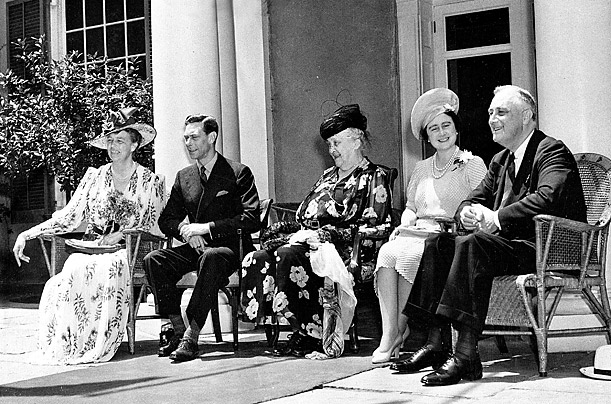
HG watched (with pleasure), “The King’s Speech”, and his thoughts, inevitably, turned to hot dogs. In one of the great public relations ploys, President Roosevelt invited the royal couple—King George VI and Elizabeth II— to the United States in 1939 for a 5 day visit. FDR, knowing that war was imminent, wanted closer ties with Greaat Britain. The visit (first to the USA for a Royal Couple since the American Revolution) was a huge success. The highlight was a picnic on the lawn of Top Cottage, FDR’s property on the Hyde Park estate. The King and Queen were served hot dogs and expressed their pleasure with this All American fare. Yes, there was also some excellent ham, smoked turkey, strawberry shortcake and other goodies. But, the hot dogs were in the spotlight. Those tube steaks played a big role in history.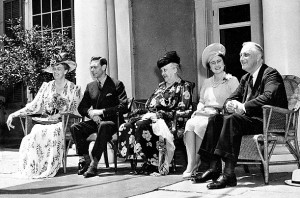
March 24th, 2011 § § permalink
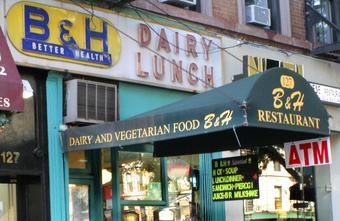
New York Times just did a big piece on vegetable burgers. The claim is that these horrors are good to eat. HG doesn’t buy it. Who needs veggie burgers? Have we run out of cows? There are so many good things to do with vegetables rather than dicing them into some semblance of a true burger. Reminds HG of the protose steak that was served at New York’s old time Kosher, non-meat restaurants. These eateries obeyed the Mosaic dietary rule that meat and dairy products not be eaten in the same meal (Kosher law contains a great more complexity than “no meat with your dairy,” but let’s leave that to the Talmudical scholars). Anyway, meatless meat was a concession to Kosher Jews who wanted a taste of flesh with their dairy. Enter the horrifying protose steak. HG believes it was made of soy, barley and wheat products. It most assuredly did not taste like meat. HG believes it tasted like a veggie burger. It was awful.
If you want a non-meat burger-like product why not tuck some falafel (Israeli fried chick pea balls) into a pita with lettuce, onion, tomato, yogurt? Add the hot sauce of your choice (harissa, sriracha, sambal oelek or just plain Tabasco). Now, that’s a veggie burger worth eating. 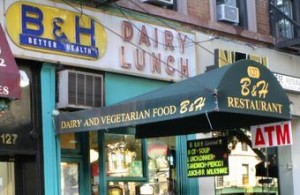
March 20th, 2011 § § permalink
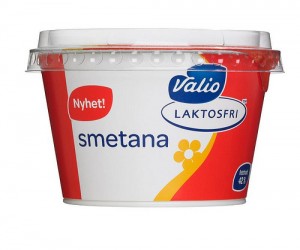
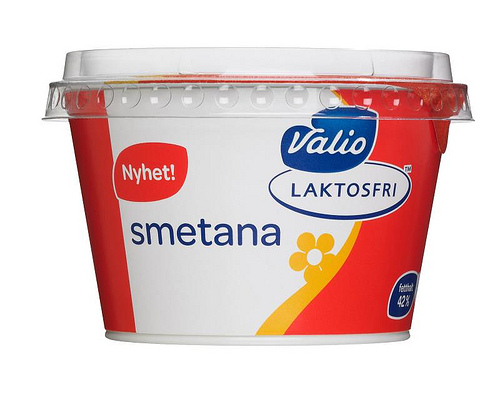
HG is a devoted fan of that wonderful writer, Ian Frazier. HG is currently engrossed in Frazier’s “Travels in Siberia.” There is a direct link between Frazier’s diet on his Siberian voyage and HG’s diet as a youngster in The Bronx. The staple Siberian food is cottage cheese and smetana (sour cream) which Frasier ate at least twice a day during his rugged travels. Little HG also had a robust ration of smetana daily. Sour cream was always called “smetana” in the HG household, a reminder of HG’s Russian ancestry. HG had smetana with boiled potatoes. Smetana with borscht. Smetana with schav (cold sorrel soup, a summer treat). Smetana with cottage cheese, pot cheese, farmer cheese. Smetana with herring. Smetana with kasha. Smetana with chopped scallions and radishes. Smetana with every variety of fruit. The little guy ingested an awful lot of smetana.
This sour cream wasn’t the pallid stuff you find in supermarket containers these days. Bronx smetana was a local product, bought at local stores where butter didn’t come in packages but was cut from a giant tub. The closest you can get to Bronx smetana is Greek yogurt. Happily, it’s easily available. Followers of HG may note that HG adds Greek yogurt to many dishes. Childhood food comforts live forever.